Trusted meters with fdia_analysis.trust
Which meters to secure so that a stealthy attack stops being stealthy.
import fdia_graph as fg
from fdia_analysis.models.config import DqnConfig, TrustConfig
from fdia_analysis.trust.base import TrustedMeters
from fdia_analysis.trust.meter_dqn import TrustedMetersDQN

train = fg.load("ieee14", split="train")
test = fg.load("ieee14", split="test", order="time")

tm = TrustedMeters(TrustConfig(k=20)).fit(train)  # the greedy row-reduction selection on the Jacobian
tm.order, tm.cost  # the meters secured in order, the attack cost after each
rep = tm.score(test)  # residual detection per family, with and without the trust

rl = TrustedMetersDQN(TrustConfig(k=20), dqn=DqnConfig(episodes=200)).fit(
    train
)  # the same selection as an MDP with a DQN policy
The idea
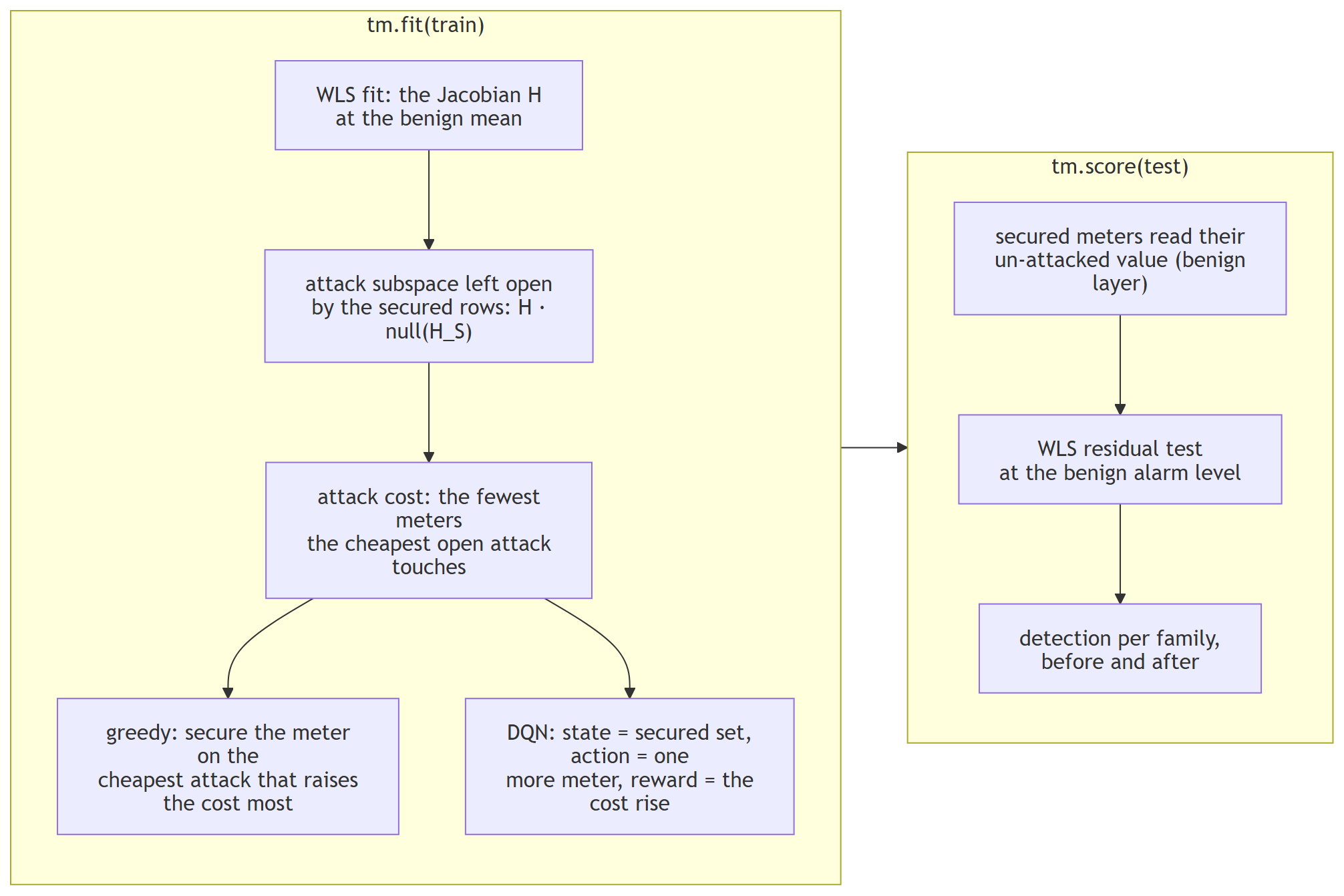
A stealthy attack a = H c moves the meters the way a real state change c would, so the residual
test does not see it. A meter the attacker cannot write pins its row: a_S = 0, so H_S c = 0
and the attack lives in the null space of the secured rows. Every secured meter shrinks that space;
once H_S has full column rank there is no stealthy attack left. The attack cost is how many
meters the cheapest attack in the open subspace must touch (the sparsest row of its reduced row
echelon basis, an upper bound on the exact NP-hard minimum). Both selectors read the same kernel,
fdia_analysis.formulas.trust (on the row reduction of fdia_graph.formulas.trust).
| class | picks the next meter by | needs |
|---|---|---|
TrustedMeters |
the greedy rule: on the cheapest open attack, the meter whose protection leaves the attacker the costliest cheapest attack | [se] |
TrustedMetersDQN |
a Q-network trained on the MDP (state the secured set, reward the cost rise), rolled out greedily; one rollout of m forward passes picks a set where the greedy rule re-evaluates every candidate at every step |
[se], [torch] |
score(test) needs a time-ordered timeline view: on every attacked frame the secured meters are
set back to their benign reading (the attacker cannot write them) and a WLS residual test at the
benign false-alarm level says whether the attack now shows. detected_before is the residual test
with every meter writable, detected_after with the trust in place.
Files
The package holds the trusted-meter selectors on a dataset.
| file | holds |
|---|---|
trust/base.py |
TrustSelector, the shared fit and score (the Jacobian at the benign mean, the attack-cost kernel, the residual test with the secured meters pinned), and TrustedMeters, the greedy selection |
trust/meter_dqn.py |
TrustedMetersDQN: the same selection as an MDP with a deep Q-network |
trust/secured.py |
secured_copy: a copy of a timeline with chosen meters secured and its temporal features recomputed |
Results
The scripts that ran the study are not part of this repository. The study wrote a run of
trust.selection to the results store: the selection, the attack-cost curve, and the detection table. Read the detection
table first. The attack cost is the sparsest row of an echelon basis of the open subspace, an upper
bound on the true sparsest attack, so it is not monotone in the secured set: on IEEE-14 the greedy
cost plateaus after its second meter, while the DQN selection's cost jumps up and down along its
twenty meters (the attack_cost rows of results/trust.selection.csv), yet its detection of Aq,
Al and Am rises from 0.00 to 0.86, 0.64 and 0.72.
WLS residual detection rate per family at a 1% benign alarm level, before and after securing 20
meters (data release v0.8.3, test split). The residual test's estimator is calibrated from
measurements only (calibrate="measured"):
| system | selector | Aq | At | Al | Am | Ad / As / Ar |
|---|---|---|---|---|---|---|
| ieee14 | greedy | 0.00 → 0.76 | 0.00 → 0.00 | 0.00 → 0.72 | 0.00 → 0.55 | 1.00 / 1.00 / 0.81 → 1.00 / 1.00 / 0.75 |
| ieee14 | DQN | 0.00 → 0.86 | 0.00 → 0.23 | 0.00 → 0.64 | 0.00 → 0.72 | 1.00 / 1.00 / 0.81 → 1.00 / 1.00 / 0.77 |
| ieee118 | greedy | 0.01 → 0.01 | 0.01 → 0.01 | 0.00 → 0.00 | 0.01 → 0.01 | 1.00 / 1.00 / 0.98 → 1.00 / 1.00 / 0.98 |
| ieee118 | DQN | 0.01 → 0.09 | 0.01 → 0.01 | 0.00 → 0.09 | 0.01 → 0.14 | 1.00 / 1.00 / 0.98 → 1.00 / 1.00 / 0.98 |
What the secured meters do for estimation and localization
The residual test is one consumer of a trusted set. tm.secured_copy(ds, out, name) writes a copy
of the timeline in which the selected meters read their benign value on every frame (the attacker
locked out of them, the tamper masks and the stored temporal features following), so every
estimator and localizer of the other two guides can be scored with the set secured;
the study does that for the greedy and the DQN
selections and writes runs of trust.secured_localization and
trust.secured_estimation to the results store.
Rule: a localization gate never down-weights a secured meter.
GatedPrior scales every meter of a flagged bus by a thousandth. On a secured copy those meters
include the secured ones, the only true readings inside the attacked region, so a plain gate throws
away the evidence the trusted set provides. GatedPrior(GateConfig(gate), secured=tm.select()) keeps the secured
meters at full weight, and that arm wins on IEEE-14.
IEEE-14, 20 secured meters, test split, node-F1 with the detection rate in parentheses:
| localizer | copy | Aq | At | Al | Am | macro-F1 / benign FA |
|---|---|---|---|---|---|---|
| residual | plain | 0.00 (0.03) | 0.00 (0.03) | 0.00 (0.03) | 0.01 (0.04) | 0.376 / 0.0017 |
| residual | greedy | 0.57 (0.94) | 0.13 (0.31) | 0.68 (1.00) | 0.60 (0.93) | 0.555 / 0.0017 |
| residual | DQN | 0.49 (0.95) | 0.11 (0.46) | 0.41 (0.77) | 0.35 (0.88) | 0.497 / 0.0017 |
| 1D CNN + Jacobian | plain | 0.89 (0.88) | 0.60 (0.71) | 0.98 (0.99) | 0.81 (0.77) | 0.835 / 0.0167 |
| 1D CNN + Jacobian | greedy | 0.87 (0.96) | 0.67 (0.73) | 1.00 (1.00) | 0.98 (0.98) | 0.826 / 0.0139 |
| 1D CNN + Jacobian | DQN | 0.87 (0.97) | 0.67 (0.75) | 0.99 (1.00) | 0.96 (0.96) | 0.854 / 0.0155 |
The trusted set opens the residual localizer on the stealthy families, the greedy set more than the
DQN's on Aq, Al and Am (macro-F1 0.376 to 0.555 and 0.497). The learned localizer already
finds the one-frame Aq without it; the trusted set lifts the sustained families, Am node-F1 from
0.81 to 0.98 and 0.96 and At from 0.60 to 0.67.
Angle mean absolute error in degrees, geometric mean over the eight record classes:
| estimator | plain | greedy | DQN |
|---|---|---|---|
| prior + Huber | 0.050 | 0.040 | 0.031 |
| prior + Huber + CNN gate | 0.044 | 0.041 | 0.033 |
| prior + Huber + CNN gate, secured meters exempt | 0.026 | 0.017 | |
| prior + Huber + residual gate, secured meters exempt | 0.030 | 0.023 | |
| prior + Huber + oracle gate | 0.041 | 0.038 | 0.030 |
| prior + Huber + oracle gate, secured meters exempt | 0.026 | 0.017 |
The DQN's 20 meters take the proposed estimator from 0.050 to 0.031 degrees with no gate and to
0.017 with the exempting CNN gate, which matches the oracle gate. The stealthy families lose most of their error (Aq 0.355 to 0.033, At 0.066 to 0.019, Al 0.048 to 0.017, Am 0.046 to
0.016) with the benign error unchanged (0.0129 to 0.0130). The residual gate, which needs no learned model, reaches 0.023 there because the secured meters made the residual see those families.
IEEE-118, the same budget of 20 meters (20 of its 720 metered channels, under 3 percent, where they were 20 of IEEE-14's 82, 24 percent):
| localizer | copy | Aq | At | Al | Am | macro-F1 / benign FA |
|---|---|---|---|---|---|---|
| residual | plain | 0.01 (0.47) | 0.01 (0.54) | 0.01 (0.50) | 0.01 (0.53) | 0.231 / 0.0072 |
| residual | greedy | 0.02 (0.50) | 0.01 (0.54) | 0.02 (0.52) | 0.02 (0.55) | 0.233 / 0.0072 |
| residual | DQN | 0.07 (0.58) | 0.02 (0.56) | 0.05 (0.61) | 0.07 (0.64) | 0.238 / 0.0072 |
| 1D CNN + Jacobian | plain | 0.64 (0.98) | 0.13 (0.83) | 0.80 (1.00) | 0.15 (0.69) | 0.360 / 0.0116 |
| 1D CNN + Jacobian | greedy | 0.66 (0.97) | 0.12 (0.82) | 0.82 (1.00) | 0.23 (0.66) | 0.355 / 0.0119 |
| 1D CNN + Jacobian | DQN | 0.57 (0.95) | 0.10 (0.78) | 0.79 (1.00) | 0.32 (0.81) | 0.370 / 0.0130 |
| estimator | plain | greedy | DQN |
|---|---|---|---|
| prior + Huber | 0.0102 | 0.0102 | 0.0101 |
| prior + Huber + CNN gate | 0.0103 | 0.0103 | 0.0103 |
| prior + Huber + CNN gate, secured meters exempt | 0.0101 | 0.0101 | |
| prior + Huber + residual gate, secured meters exempt | 0.0156 | 0.0153 | |
| prior + Huber + oracle gate | 0.0100 | 0.0100 | 0.0100 |
| prior + Huber + oracle gate, secured meters exempt | 0.0095 | 0.0097 |
On IEEE-118 twenty meters barely move anything. The DQN set raises the residual localizer's
stealthy detection rates a few points and its macro-F1 from 0.231 to 0.238, the learned
localizer's Am node-F1 rises from 0.15 to 0.32 while its Aq falls from 0.64 to 0.57, and the
estimator barely moves with no gate (0.0102 to 0.0101). Twenty meters were a quarter of
IEEE-14's channels and are under 3 percent of IEEE-118's; the budget has to scale with the system
for the gains to follow.
Source: the multi-snapshot attack and the trusted-PMU defence of [WU26] (docs/reference/REFERENCES.md).