Repo roadmap
The package is two halves, and the folder structure shows it: the top level is the SDK (load and
serve data), engine/ is the theory (power-flow physics, meter models, attack math). Loading runs
on the base install; the generation side — engine/ plus its drivers generation.py/profiles.py —
needs the [generate] extra. Users only touch src/fdia_graph/__init__.py's fg.* functions.
src/fdia_graph/          (the package root)
├── __init__.py                      fg.* public API
├── dataset.py registry.py download.py     SDK: load path
├── streams.py torch_data.py               SDK: stream path
├── generation.py profiles.py              SDK: generation drivers
├── se/                              state estimation (WLS, robust, subspace prior)
├── localization/                    per-bus attack localization (swing, delta, residual)
└── engine/                          theory: FdiaGenerator
    ├── core.py                        assembly + targeting
    ├── measurement.py                 meters + noise  h(x)
    ├── physics.py                     AC solves, Ybus
    ├── attacks.py                     the six families
    └── base.py                        shared typed contract
How the three paths connect (generate produces the shard the load path serves):
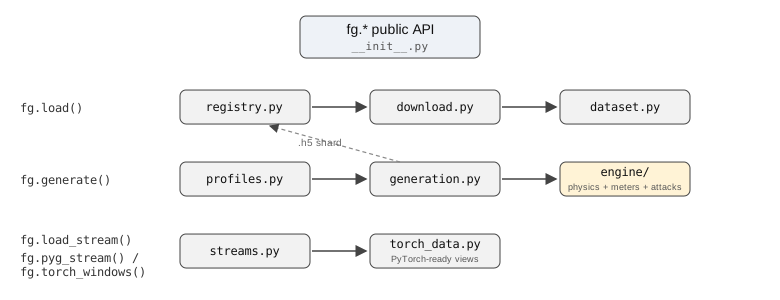
SDK (package root src/fdia_graph/) — load and serve data
| File | What it is |
|---|---|
__init__.py |
Public API. Thin wrappers with lazy imports so load() users never need torch/pandapower. |
dataset.py |
FdiaGraph: Dataset over one .h5 shard. Splits, family filters, units, dict/PyG loaders. |
registry.py |
Dataset version control. (name, release) → download spec; register_local for generated sets. |
download.py |
Fetch a shard to ~/.cache/fdia_graph, sha256-verified, atomic rename. |
streams.py |
Continuous attacked time series (generate_stream/load_stream) + windowing for LSTMs. |
torch_data.py |
pyg_stream/torch_windows: streams as ready PyG graphs / per-bus sequence tensors. |
generation.py |
generate(): drives the engine over a state pool, writes + registers the shard. |
profiles.py |
ISO load profiles (NYISO/CAISO/ERCOT) → normalized scaling → AC operating-state pools. |
se/ |
sklearn-style state estimation: SEBase chord-Newton core + WLS/robust/prior classes. |
localization/ |
sklearn-style per-bus localization: LocalizerBase FA-budget calibration + swing/delta/residual classes. |
engine/ — the physics, meters, and attack math
| File | What it is |
|---|---|
core.py |
FdiaGenerator assembly: grid setup, meter plan, RNG, attack targeting. |
measurement.py |
Mixin: meter placement + accuracy-class noise (per-meter bias + per-scan jitter); h(x). |
physics.py |
Mixin: AC solves, Ybus, emit exact measurements from a stored state. |
attacks.py |
Mixin: the six attack families (Aq Ad As Ar At Al). |
base.py |
Typed attribute contract the three mixins share (no runtime behavior). |
Docs layout
docs/reference/ is lookup material, docs/guides/ is task walkthroughs, docs/figures/ holds
every image and data sidecar. docs/se/ and docs/localization/ are per-module example folders:
a runnable script, a README that reads the results, and the results/ it produced (metrics JSON,
figure, CSV sidecar). New docs go in reference or guides; new module examples get a folder like
those two.
Reading order for new students
README.md— install + quickstart.docs/reference/DATA_DICTIONARY.md— what every array and shape means (node_x,edge_attr, ...).- This page — which file does what.
docs/reference/CONCEPTS_TO_CODE.md— paper formulas → the code that implements them.docs/reference/EXAMPLES.md— full training examples to copy from.docs/guides/state_estimation.md— measurements in, better-than-WLS state out.