State estimation — recovering the true state with fdia_graph.se
Given a scan of noisy, possibly attacked measurements, estimate the true bus voltages and angles.
Every shard ships a noiseless attack-free clean layer, so the estimate is scored against exact
ground truth. The module is sklearn style: one base class owns the shared machinery (the AC
measurement model, the chord-Newton solve, meter-weight calibration, the classical 2N-1 state
with the slack angle as reference), and each method class changes exactly one thing, so comparing
two methods compares estimators, not implementations.
import fdia_graph as fg
from fdia_graph.se import WLS, AdaptiveWeighting, SubspacePrior

train = fg.load("ieee14", split="train")
test  = fg.load("ieee14", split="test")

est  = SubspacePrior(rank_frac=0.2, reweight="huber", c=1.5).fit(train)
xhat = est.estimate(test)   # [n, 2N-1] = [theta rad (non-slack) | V pu (all buses)]
rep  = est.score(test)      # per-family angle/voltage MAE vs the clean truth
Needs the [se] extra (pip install "fdia-graph[se]") and a v0.7.2+ shard (the clean layer is
the truth). See also the walkthrough in ../guides/state_estimation.md.
The method classes
| Class | What it changes | Knobs |
|---|---|---|
WLS |
Nothing — the audited baseline, least squares weighted by accuracy-class meter error | — |
AdaptiveWeighting |
Iteratively reweighted least squares (the Huber M-estimator) | c |
ResidualRemoval |
Largest-normalized-residual removal with an observability guard | threshold |
SubspacePrior |
Restricts the solve to a low-rank benign operating subspace, optionally composed with Huber | rank_frac, reweight |
Results — IEEE-14, test split, validation-selected hyperparameters
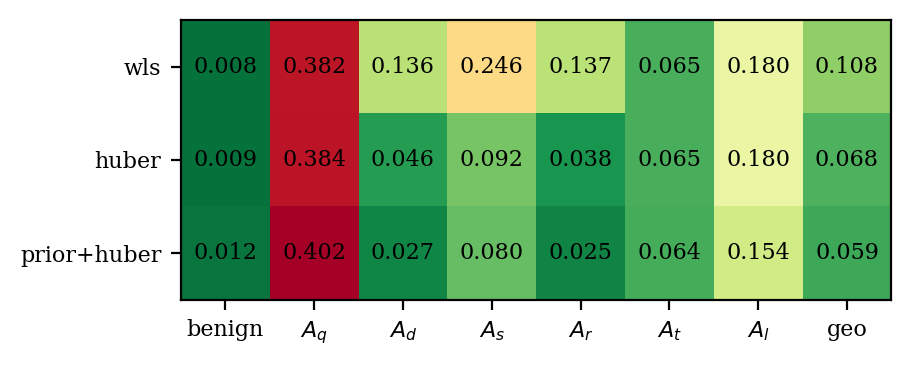
Angle MAE in degrees per family, geo is the geometric mean over families (full metrics including
voltage MAE in results/se_ieee14.json, figure data in the CSV sidecar):
| method | benign | Aq | Ad | As | Ar | At | Al | geo |
|---|---|---|---|---|---|---|---|---|
| wls | 0.008 | 0.382 | 0.136 | 0.246 | 0.137 | 0.065 | 0.180 | 0.108 |
| huber | 0.009 | 0.384 | 0.046 | 0.092 | 0.038 | 0.065 | 0.180 | 0.068 |
| prior+huber | 0.012 | 0.402 | 0.027 | 0.080 | 0.025 | 0.064 | 0.154 | 0.059 |
Two readings:
- Robustness cleans up what it can see. The in-place corruption families (
Ad/As/Ar) leave large residuals, so Huber reweighting cuts their angle error 3–5x and the operating-point prior tightens it further (geo 0.108 to 0.059 degrees, and the voltage geo improves 6x, see the JSON). - The stealthy families barely move.
Aq/At/Alre-solve the physics, so their measurements are consistent and there is nothing for a robust weight or a residual test to reject — every method lands within a few percent of WLS there. Recovering the truth under a stealthy attack is not a weighting problem; it needs temporal information (see../localization/README.mdfor the detection side of that same story).
Regenerate
python docs/se/run_se.py                       # IEEE-14, minutes on a laptop
FG_SYSTEM=ieee118 python docs/se/run_se.py     # any system in the ladder
Outputs land in results/: the metrics JSON, the figure, and a CSV data sidecar so the figure can
be restyled without re-running.